Mar
24
2026
Mercedes Brown, BMP Director of Race Equity Assessment

There is no shortage of evidence that racial equity work remains necessary. What feels different right now is what it takes to continue.
As a Black woman leading this work, I want to be honest about that. This moment carries a different weight. The level of scrutiny, the pushback, and the ways this work is being politicized, and at times dismissed, feel more pronounced than at other points in my career. There are moments where the work feels more exposed and more contested, and if I am being real, more personal.
At the same time, the need for this work has not gone away. If anything, it has become clearer.
Across the nonprofit sector, I continue to see organizations holding a similar tension. There is genuine commitment to advancing racial equity. At the same time, organizations are navigating real pressures, leadership transitions, implementation fatigue, external backlash, and competing priorities. All of this shapes what is possible, what feels risky, and what ultimately gets sustained over time. In that kind of environment, the question is not simply whether organizations value equity, but whether they can remain aligned with that commitment as conditions shift around them.
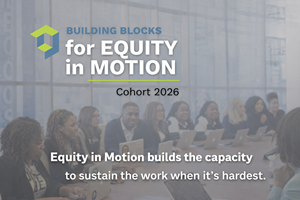
That is the context in which we launched Building Blocks for Equity in Motion, our inaugural six-month Community of Practice through Building Blocks for Change, grounded in insights from our Race Equity Assessment, which examines leadership, learning, conversation, and voice to understand how equity shows up in organizational practice.
This Community of Practice is intentionally designed for organizations that are not at the beginning of their equity journey. These are organizations that have already invested in building shared language, conducting assessments, and naming equity as a priority, and are now navigating what it takes to sustain that work in practice. In our experience, the most persistent challenges emerge at this stage. Organizations are not asking whether to begin, but how to continue with clarity, consistency, and integrity.
The inaugural cohort brings together 12 organizations from across the country, representing a range of geographies, issue areas, and political contexts. We are not publicly naming participating organizations at this stage, a deliberate choice given both the nature of the work and the broader sociopolitical climate. At the same time, it is important to acknowledge that this work is taking place across environments where equity is increasingly contested, questioned, and, in some cases, actively challenged.
Over the course of six months, participants will engage in a structured, applied learning experience focused on sustaining equity practice through organizational alignment, peer learning, and strategic adaptation. Together, they will work through questions related to navigating resistance, maintaining continuity through leadership transitions, translating equity strategy into daily operations, and strengthening shared accountability across teams.
At the center of this work is a pattern we continue to see across organizations. Equity efforts often begin with clarity and momentum, but over time, as conditions shift, that alignment can weaken. Priorities change, leadership turns over, or external pressures intensify, and organizations find themselves revisiting foundational conversations rather than building on what already exists. That cycle is not only inefficient, it can also be discouraging for the people doing the work.
Building Blocks for Equity in Motion is grounded in a different approach. It recognizes that equity work is not static and that sustaining it requires ongoing calibration. Rather than restarting, organizations need the capacity to assess what is shifting, identify where alignment is fraying, and make strategic adjustments that allow the work to continue with integrity.
For me, this Community of Practice is also about creating space for honesty. The reality is that sustaining equity work in this moment is not easy. It requires clarity, discipline, and, at times, a willingness to move forward even when the environment is uncertain or unsupportive. It also requires community spaces where organizations can learn from one another, share what is working, and navigate challenges without isolation.
We are honored to be in partnership with a cohort of organizations that are choosing to remain engaged in this work, not because it is easy, but because it is necessary.
As the cohort progresses, we will share reflections and emerging patterns in ways that contribute to broader field learning while maintaining the trust that makes this work possible.
Because the goal is not to begin again, it is to sustain the work with clarity, intention, and collective strength.